On September 1st, auto-suisse published figures for the Swiss automobile market for August. At first glance, two pieces of information that seem to contradict each other. On closer inspection, they tell exactly the same story — and this story directly concerns anyone who buys, sells or stocks used cars in Switzerland.
August 2026: the Swiss paradox in two figures
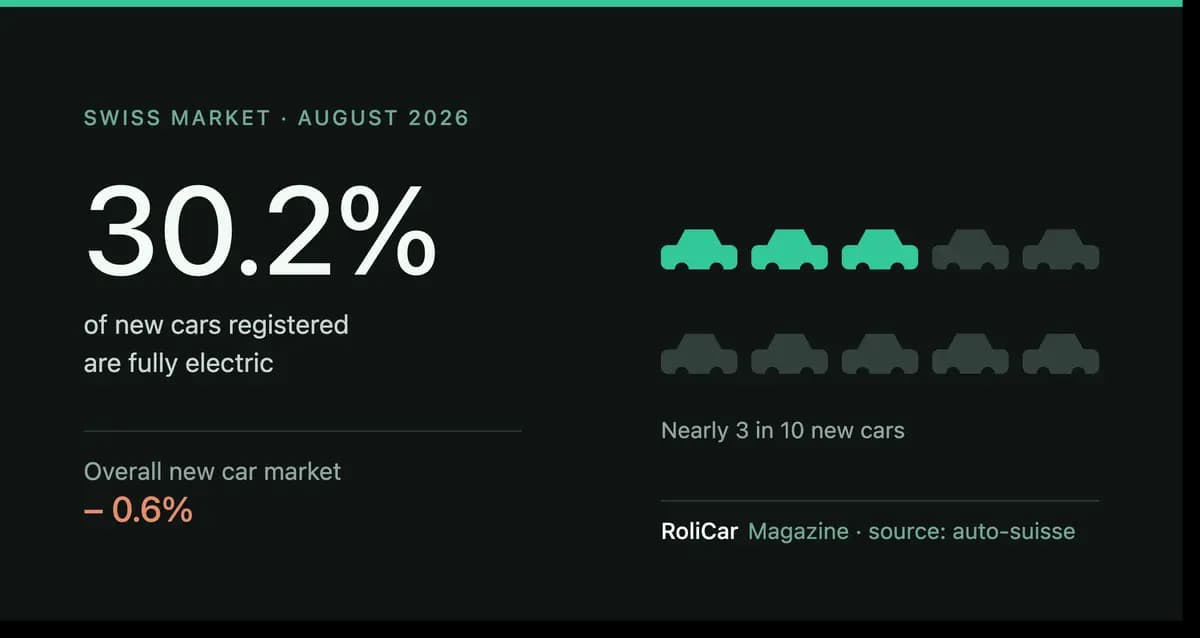
Figure No. 1: 30.2 %. This is the share of 100 % electric cars among new registrations in August in Switzerland and Liechtenstein. An increase of 48.7 % compared to August 2025. Nearly a third of the new market, in one month.
Figure No. 2: –0.6 %. This is the change in the overall market for the same August, with 16,047 registrations. Since January, 151,589 new cars have been put into circulation, an increase of only 1.8 %. In the meantime, the European market showed growth of over 5 % at mid-year.
In other words: electrification is advancing fast, but it's advancing in a market that itself isn't advancing. It's not additional buyers switching to electric. It's the same cake, sliced differently.
For a professional, the nuance is not academic. A growing market absorbs stock errors. A flat market that is being recomposed does not: each poorly purchased vehicle remains on the lot.
A historic first that went almost unnoticed
The press release contains information that would have deserved more headlines. Since the beginning of the year, vehicles known as "plug-in" — electric and plug-in hybrids combined — account for 37.2 % of registrations. They thus exceed, for the first time, conventional hybrids (36.7 %).
The rest of the table reads itself:
Pure petrol: 20.6 %
Diesel: 5.5 %
In August, one new car in five still ran exclusively on fossil fuel
Another telling Swiss detail: more than half of the cars sold since January are equipped with all-wheel drive (52.5 %). The country remains true to itself — heavy, powerful, four-wheel drive. Which, as we'll see, has regulatory consequences.
And a trend within the trend: in August, plug-in hybrids fell 4.3 % while electric vehicles surged. The PHEV, long presented as a reassuring intermediate step, is beginning to be overtaken by 100 % electric. Something to watch closely when building stock at 24 or 36 months.
Meanwhile, Europe loosens the grip
December 2025, Brussels. The European Commission presents its "automotive package" and confirms a shift that few people had anticipated so sharply: the 2035 target changes from a reduction of 100 % of CO2 emissions from new fleets to 90 %. The sale of new combustion vehicles after 2035 is therefore no longer formally condemned — it becomes residual, regulated, but possible.
Added to this is a whole series of relief valves:
a so-called banking & borrowing mechanism between 2030 and 2032, which allows manufacturers to smooth their results from year to year;
for light commercial vehicles, the 2030 target reduced from 50 % to 40 % reduction;
targeted adjustments for heavy-duty vehicles;
and, from 2025, a regulation allowing manufacturers to calculate their CO2 compliance on average over three years (2025–2027) rather than year by year.
The industrial message is clear: Europe maintains course but lengthens the landing strip.
And Switzerland? It tightens one notch
This is where the topic becomes distinctly Swiss.
Our country applies CO2 requirements modeled on those of the EU. Since January 1st, 2025, the average of new passenger cars registered here must not exceed 93.6 g of CO2/km in WLTP, on pain of sanctions paid by importers — and ultimately passed on to prices.
Except the Swiss context is structurally tougher. Federal analyses make it clear: because of higher purchasing power, more powerful engines, a massive proportion of 4x4s and higher kerb weights, the average emissions of new cars in Switzerland exceed those of the EU by 20 to 25 g/km. Same rule, more difficult playing field.
And to that is added taxation:
Since January 1st, 2024, electric cars are no longer exempt from the 4 % import tax. They have been exempt since 1997.
From 2030, the Federal Council wants to introduce a replacement charge on electric vehicles to compensate for the erosion of the mineral oil tax that funds FORTA and network maintenance. Two variants were put out for consultation: a mileage-based charge of approximately 5.4 ct./km on average for a car, or a tax of 22.8 ct./kWh levied at charging, including private chargers. The project requires a constitutional amendment — so a popular vote.
The consultation, closed in January 2026, triggered broad and cross-party opposition, from the TCS to political parties to industry associations. The Federal Council, for its part, continues to bank on implementation in 2030 in its "Transport '45" planning.
Thomas Rücker, director of auto-suisse, says as much in the August press release: he is calling for deregulation and relaxation of CO2 requirements in line with the rest of Europe and considers any additional tax on electric vehicles counterproductive.
Let's sum up the situation. Europe is easing up. Switzerland maintains a CO2 target designed for a lighter fleet than its own, taxes the import of electric vehicles since 2024 and is preparing a mileage charge for 2030. All this in a market that isn't growing.
The blind spot: the real wave is coming in the used car market
This is what nobody talks about enough.
In Switzerland, approximately four times more used cars are sold than new cars. Now, everything that is registered as new today mechanically constitutes the used car stock of 2029 and 2030. A share of 30 % electric in new registrations in August 2026 is not an environmental statistic. It's a delivery schedule for the fleets of Swiss garages.
And this wave arrives with problems all its own.
The first is residual value. On the European used car market, electric vehicles suffer from a structural lag: electric vehicles are massively put into circulation by fleets and leasing, while the used car market is dominated by private individuals who still largely demand combustion vehicles. Supply arrives faster than demand shifts. French professionals were already talking about this bluntly in spring 2026, backed by depreciation figures.
The second is the very nature of the object. On a used combustion vehicle, the service record and mileage tell the essential story. On a used electric vehicle, the decisive variable is the health of the battery — the so-called SoH. The same model, same year, same mileage, can differ by several thousand francs depending on remaining capacity. One threshold comes up everywhere in market analyses: below 80 % capacity after a few years, the perception of risk rises and the price drops.
Which raises a very concrete question: does this information appear in the listings? In the vast majority of cases, no. You'll find the power, the color of the wheels, the number of airbags — not the only piece of data that actually determines the vehicle's value.
The third is regulatory uncertainty itself. When a buyer doesn't know whether they'll pay 5.4 ct./km, 22.8 ct./kWh or nothing at all from 2030 on, they don't wait calmly: they defer their decision, or they negotiate harder. Regulatory uncertainty is an invisible discount that is paid on the used car market before it even exists in law.
What it changes in concrete terms, right now
For a Swiss garage or professional seller, these figures translate into a few very down-to-earth reflexes:
Document the battery. A SoH report attached to the listing is not a marketing gimmick. It's what transforms doubt into a sales argument and what justifies a price. Used electric car buyers in 2027 will all ask the question.
Look at the PHEV with caution. August's decline is not yet a heavy trend, but when the intermediate segment is being overtaken by pure electric in new registrations, the question of its liquidity in used cars will arise within two to three years.
Don't confuse a flat market with a soft market. The market isn't really contracting: it's being recomposed. Volumes hold, structure changes. These are two situations that call for very different purchasing policies.
Treat regulation as a commercial parameter. The 2030 charge will go through a popular vote. Until then, the best commercial response remains transparency: clearly explain what is decided, what isn't and what it changes for the buyer.
The final word
There is something very Swiss about August 2026: a transition that is actually advancing, driven by buyers, within a political framework that hesitates between encouraging and taxing. The figures themselves don't debate. A third of the new market has switched to electric. These cars will drive here for fifteen years and change hands three or four times.
So the question is no longer whether electric used cars will arrive in Swiss lots. They're already here. The question is whether the industry will know how to sell them properly — with the right information, the right tools and a readable market.
That's precisely what we're trying to build, here, in Switzerland, at human scale.
Sources
auto-suisse — Steady demand for electric cars in a tight market, press release of September 1st, 2026
Federal Office of Energy — Requirements concerning CO2 emissions from new vehicles
Federal Council / OFROU — Charge on electric vehicles, consultation opened September 26th, 2025
European Commission — Automotive package of December 16th, 2025; regulation (EU) 2025/1214
SuisseEnergie — Buying a used electric car