Porsche will produce fewer cars and sell them at higher prices. The announcement made headlines, but it's not a Porsche story. It tells of a shift across the entire European automotive industry, caught between China no longer buying German, shrinking margins, and Chinese brands twice as cheap. And in this equation, it's the buyer who pays. Unless they look at the right side of the market.
What Porsche announced
From its development center in Weissach, the brand's chief, Michael Leiters, presented a roadmap that RTS sums up in one formula: value before volume. The numbers speak for themselves:
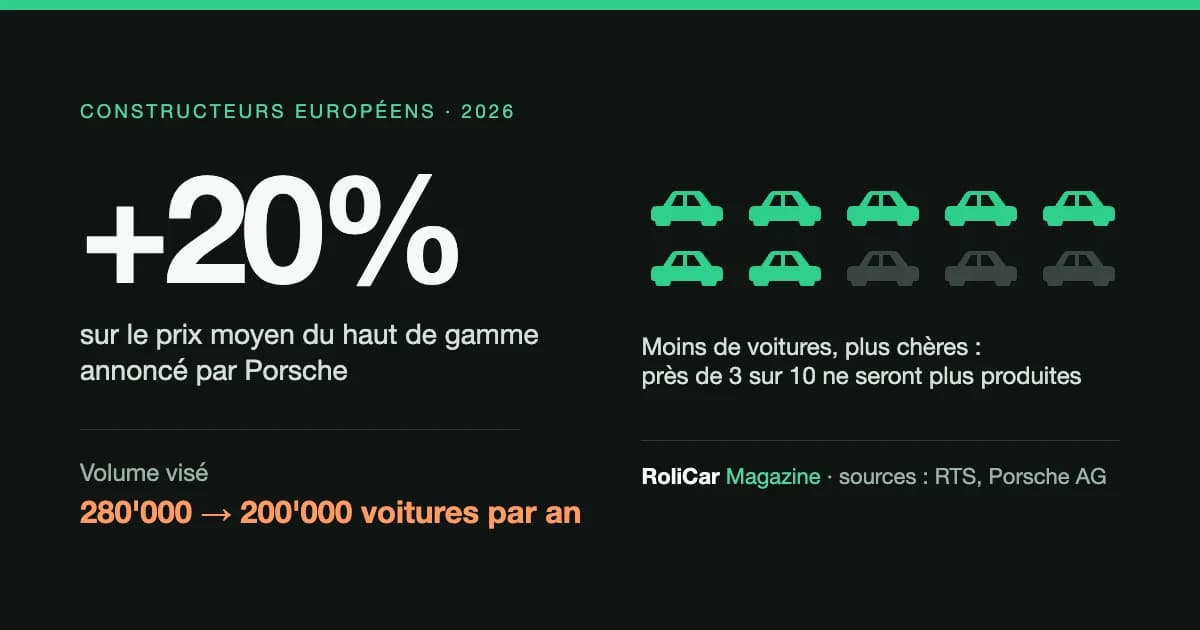
- 280,000 cars sold in 2025, 10% less than in 2024;
- a break-even threshold reduced to 200,000 cars per year: the company is reorganizing to make money even while selling far fewer;
- 20% fewer variants in the catalog;
- a rise of approximately 20% in the average price of high-end models, eventually;
- 9,000 jobs cut by 2030, a quarter of the workforce;
- a Chinese network halved, from more than 150 sales points to 75 or 80 by year-end.
And a promise for purists: the 911 will never go electric. The symbol is clear. Porsche is abandoning the volume race that had carried it to 300,000 cars and is becoming what it was before: a rare brand, worth paying for.
Why now
Three forces have converged. The first is China. For fifteen years, Chinese buyers made the fortune of German brands. They now buy Chinese: BYD, Xiaomi, Nio. Porsche's deliveries there fell by nearly a third in the first half of 2026.
The second is premium electric vehicles, whose demand hasn't matched investments. Porsche built factories and platforms for volumes that never materialized, and must now develop internal combustion engines in parallel that it thought it was abandoning.
The third is profitability. According to the Journal de l'Automobile, the brand's operating margin fell to 1.1%, a figure unthinkable three years ago for a company that regularly exceeded 15%. American tariffs, set at 15% since summer 2025, added weight to a manufacturer that exports every single car.
All of Europe's automotive industry is following the same path
What stands out is that Porsche is simply saying out loud what its competitors are experiencing quietly. According to an EY study cited by L'argus, profits at the three major German groups fell 23% in the first quarter of 2026. BMW sold 1.15 million cars in the first half (−4.2%) and now targets a margin of 1 to 3%, versus 4 to 6% previously. The Volkswagen Group shows operating profitability of 3.8%. Mercedes maintains the continent's best profitability per vehicle, but its forecasts too are being revised downward.
In response, two opposing strategies are emerging.
Luxury is becoming scarce. This is the Ferrari path, which Porsche is joining today: fewer than 14,000 cars per year, an order book stretching to 2027, and margins near 40%. When the product is rare, it's the customer who waits, not the factory.
Generalists are slashing prices. Audi cut the Q6 e-tron by 7,000 euros in February. At Stellantis, Opel and Fiat reduced their average prices to regain volume, while DS maintained them. For these brands, there's no exclusivity to be had: there's a price war to win, and the opponent is no longer called Renault or Toyota.
The Chinese are arriving, and Switzerland is on the front line
In Europe, Chinese brands posted record numbers for the first half of 2026. In Switzerland, the movement is even faster. According to consultant Guido Biffiger, cited by UPSA, their market share rose from just over 3% in 2025 to 6.5% in the first half of 2026. BYD registered 4,568 cars over nine months, versus 517 a year earlier, and now holds 2.6% of the market; Leapmotor, distributed by the Emil Frey group, is at 1,607.
There's a reason for this Swiss advantage. The European Union imposed compensatory tariffs at the end of 2024 on electric vehicles manufactured in China, up to 35% depending on the brand, and has been negotiating floor prices to replace them since January. Switzerland, outside the Union, does not apply these surcharges. For a Chinese manufacturer, the Swiss market is thus both a testing ground and a showcase; for European brands based here, it's additional pressure on prices, without the shield they have in Munich or Paris.
The bill for the buyer
Fewer cars, more expensive: Porsche's formula also describes the new car market as a whole. In France, the average price of a new car exceeded €36,000, up 3.6% year-on-year according to AAA-Data. A Roland Berger study cited by Attirance Auto puts the increase at over €7,600 in six years, of which €1,000 to €2,500 per car comes from regulation (safety, emissions) and a strong mix effect: manufacturers have abandoned small, low-margin models.
The reduction in variants comes at the cost of choice: fewer engine options, fewer trim levels, options bundled into packages. And a new element is added: Brussels proposed in December to relax the 2035 target, which would shift from −100% to −90% emissions for new cars. The text is not yet adopted, but the signal is heard: the internal combustion engine has another decade ahead of it, and with it the resale value of gasoline cars.
In Switzerland, used cars are becoming the real market
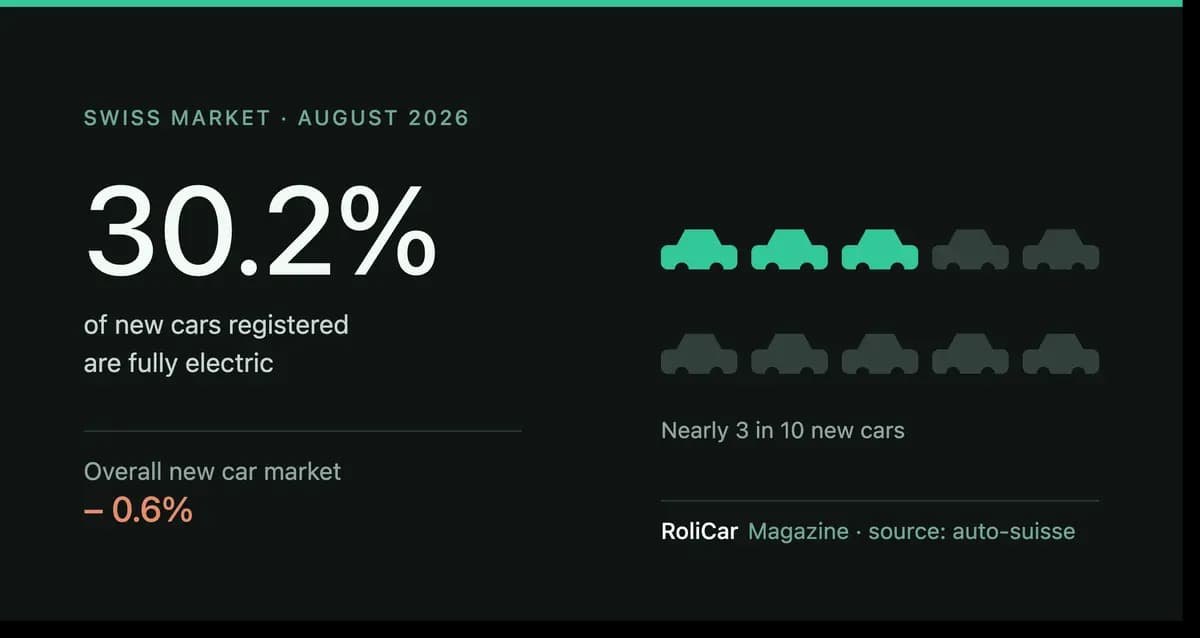
Switzerland's new car market is stirring without taking off: 173,537 registrations over nine months (+2.8%), a September month at +9.6%, and for the first time, more than one new car in three is 100% electric (35.7%), driven by record fuel prices. We detailed this picture in our September article.
But while the new car market shrinks and becomes more expensive, the used car market is deep. Our October price index is based on 11,712 active listings in Switzerland. The median price stands at CHF 26,500.–, with half of cars between CHF 15,500.– and CHF 45,050.–. For a used electric, the median is CHF 34,000.–; for gasoline, CHF 25,000.–; for diesel, CHF 20,990.–.
And Porsche? 796 listings, a median price of CHF 69,000.–, half the supply between CHF 39,900.– and CHF 105,750.–. In other words, while the brand raises its new car prices by 20%, a ten-year-old 911, well-maintained and of Swiss origin, still negotiates around CHF 70,000.–.